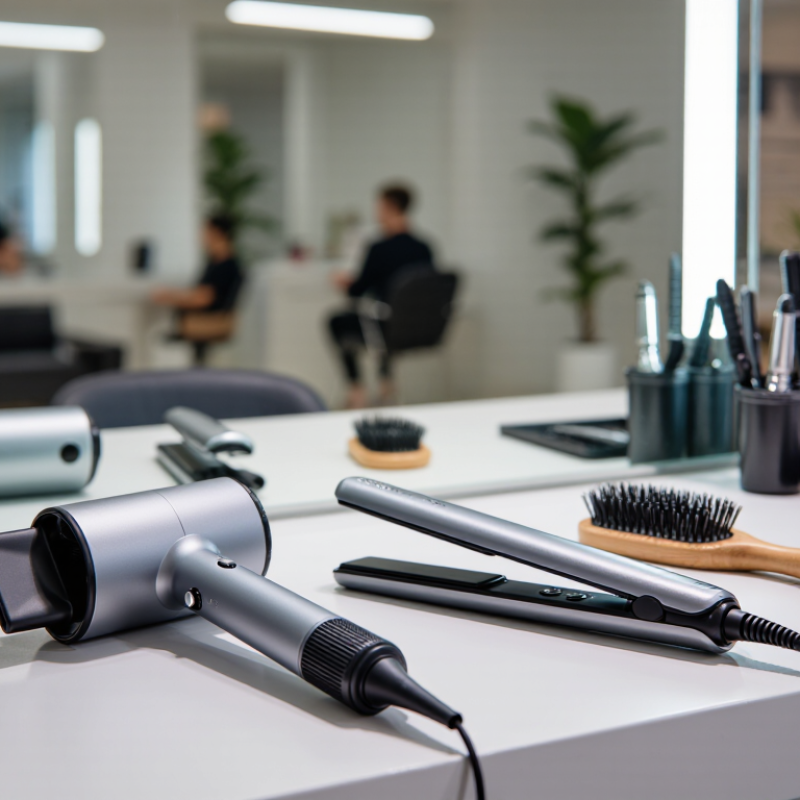
Why do professional salons prefer certain styling tools? The answer begins at the station: a dryer that keeps pace with a full appointment book, an iron with steady temperature control, and handles that feel balanced during repeated use. Small differences matter. They affect timing, finish, and stylist comfort across a long day. But premium branding alone proves little; a tool must suit the service, hair type, and skill using it.
The U.S. Bureau of Labor Statistics projects employment for barbers, hairstylists, and cosmetologists to grow 7% from 2023 to 2033, faster than the average for all occupations. That is a useful demand signal, not proof of tool-buying trends. The BLS figure measures jobs, not salon equipment purchases. Vidal Sassoon’s well-known salon principle, “If you don’t look good, we don’t look good,” captures the client-facing standard behind careful tool choices. It is not a tool-selection rule, though. In 2026, salons can assess heat consistency, airflow, grip, durability, and serviceability against their actual workload. A tool that performs beautifully in a product demo may feel tiring after six blowouts. That detail deserves attention. Evidence also has limits: published market reports often estimate broad retail categories, while salon-specific purchasing data can be scarce. The best choice is therefore practical, testable, and suited to the team—not simply the newest model.
Salon Demand in 2026: BLS Projects 5% Stylist Job Growth, 2022–32
The subtitle’s 5% figure needs a date check. For 2022–32, the U.S. Bureau of Labor Statistics (BLS) projected 8% growth for hairdressers, hairstylists, and cosmetologists. Its Occupational Outlook Handbook also estimated about 65,000 annual job openings. These figures describe employment prospects, not guaranteed hiring at every salon. Openings include jobs created by growth and workers leaving the occupation. That distinction matters.
A growing workforce makes dependable tools valuable during packed appointment books. The BLS notes that hairstylists often stand for long periods, so a lighter dryer or well-balanced shears may reduce strain across a shift. Adjustable heat and airflow can help stylists adapt to fine, thick, or damp hair without relying on one setting. Small details count. A cool handle and an easy-to-clean surface can matter between clients. Still, BLS employment projections do not measure tool preferences or prove that premium equipment improves results. Salon owners should weigh staff feedback, maintenance costs, and actual daily use. A costly upgrade may look impressive, yet feel wrong after six hours behind the chair.
Dryer Performance: Professional Models Commonly Deliver 1,800–2,000 Watts
Professional salon dryers commonly carry rated inputs of 1,800–2,000 watts. That figure describes electrical power, not drying speed by itself. Airflow, heat control, nozzle design, and the stylist’s technique also affect how quickly a section dries. In a busy salon, a strong, steady air stream can help move from damp roots to smooth ends without lingering on one spot. Small detail, big difference. A higher wattage is not automatically better for every hair type.
The U.S. Department of Energy’s Energy Saver guidance estimates energy use by multiplying watts by operating hours, then dividing by 1,000. At full rated power, a 1,800-watt dryer used for ten minutes would consume about 0.30 kilowatt-hours; a 2,000-watt model would use about 0.33. Actual consumption can vary as heat cycles and settings change. That distinction is easy to overlook. UL 859, a safety standard for personal grooming appliances, is relevant when assessing electrical safety, but it does not rank drying performance. Salons should check the tool’s rated input, cord condition, heat settings, and feel in hand. A powerful dryer may still feel tiring after repeated use, and wattage alone cannot settle that question.
Why Salons Prefer Professional Styling Tools in 2026
Professional Hair Dryer Power: 1,800–2,000 W
Professional hair dryers commonly deliver 1,800–2,000 watts. The midpoint shown is calculated from the range endpoints; it does not represent a measured model or survey result.
Heat Control: Flat-Iron Temperature Settings Commonly Span 250–450°F
Flat-iron settings commonly range from 250 to 450°F (about 121 to 232°C), but the highest setting is not automatically the most effective. Fine, lightened, or fragile hair often needs less heat; coarse or resistant hair may need more. Hair condition and section size matter, too. A few degrees can change the result.
Heat exposure adds up. A 2011 laboratory study in Annals of Dermatology found greater surface damage when hair was exposed to a 95°C dryer environment than at 47°C. That study examined blow-drying, not flat irons, so its results do not establish a safe iron setting. Still, it reinforces a useful point: temperature and exposure both count. Salon routines are not always perfect, either; rushing a section can invite repeated passes.
Tips: Start low, test a small, dry section, and raise the setting only if needed. Use thin, even sections and one controlled pass when possible. Small sections matter. Note the setting that works for each client, then reassess after chemical services or visible changes in hair condition.
Daily Salon Use: Evaluate Tool Weight, Cord Length, and Warranty
A styling tool can feel comfortable for five minutes, then heavy after a full day of blowouts. For daily salon use, compare its weight fully assembled, including attachments. Hold it at working height and mimic repeated wrist turns. Small test. A few extra ounces can matter during back-to-back appointments, especially with overhead styling. Still, the lightest tool is not always the easiest to control; grip shape and balance matter too.
Check cord length against the salon’s actual workstation layout. A short cord may pull when the chair or client moves, while an overly long one can tangle near carts and chair legs. Look for a flexible cord that reaches the outlet without stretching across a walkway. A swivel connection can reduce twisting, but it does not replace careful cord placement. Measure the space, not just the product description.
Read warranty terms before buying, including coverage length, exclusions, and service requirements. Salon use may differ from household use under some policies, so confirm that professional use is covered in writing. Keep the receipt and warranty details where staff can find them. A longer warranty sounds reassuring, but repair delays can still interrupt a workday. That part is easy to overlook. Test the tool during a realistic shift when possible, and note what feels tiring; one short demo may not reveal much.
Salon ROI: Compare Cost per Service, Repair Needs, and Tool Lifespan
In 2026, salons may judge styling tools by more than their purchase price. A tool’s real cost is what it takes to deliver each service reliably. For a simple estimate, divide its purchase price and repair costs by the number of services completed before replacement.
Consider a $180 tool used three times daily, five days a week, for two years. At roughly 250 working days each year, that is about 1,500 services, or 12 cents per service before repairs. A cheaper $90 tool that lasts nine months could cost more per service, even before downtime is counted. Downtime matters. A warm-up failure during a busy afternoon can delay appointments and disrupt a stylist’s routine.
Repair needs also change the calculation. Track service records, replacement parts, and how often a tool needs attention; small expenses can accumulate. Check cords, switches, and temperature consistency regularly, and follow the maker’s care instructions. Numbers vary. Workload, cleaning habits, and hair types all affect wear, so these figures are only an example. That estimate is neat, perhaps too neat: real salon use is uneven, and a tool that lasts longer on paper may still perform inconsistently. Compare actual cost per service with dependable performance and repair history.
Why Do Salons Prefer the Best Styling Tools in 2026? - Salon ROI: Compare Cost per Service, Repair Needs, and Tool Lifespan
Illustrative salon-planning comparison of common professional tool categories. Lower cost per service can help salons evaluate durability and ongoing maintenance alongside purchase price.
| Tool Category |
Example Purchase Cost |
Assumed Useful Life |
Estimated Annual Repairs |
Annual Services Using Tool |
Estimated Tool Cost per Service |
| Professional blow dryer |
$250 |
3 years |
$45 |
1,200 |
$0.107 |
| Professional flat iron |
$180 |
3 years |
$30 |
800 |
$0.113 |
| Professional curling iron |
$120 |
2.5 years |
$20 |
600 |
$0.113 |
| Professional clipper |
$220 |
4 years |
$50 |
1,000 |
$0.105 |
| Salon hood dryer |
$600 |
6 years |
$80 |
500 |
$0.360 |
Calculation: (purchase cost ÷ assumed useful life in years + estimated annual repair cost) ÷ annual services using the tool. These are illustrative planning estimates, not quoted market averages. Actual costs and lifespan vary with usage, maintenance, repair pricing, and local purchasing costs. Labor, electricity, tax, and consumables are excluded.
Conclusion
In 2026, salons are choosing styling tools with performance, comfort, and long-term value in mind. With the U.S. Bureau of Labor Statistics projecting 5% growth in stylist jobs from 2022 to 2032, dependable equipment can help busy professionals serve more clients efficiently. Many professional dryers deliver 1,800–2,000 watts, while flat irons commonly offer temperature settings from 250°F to 450°F, giving stylists options for different hair types and styling needs. These specifications help explain why do professional salons prefer certain styling tools: consistent results and adjustable heat are essential for everyday work.
Salons also consider how a tool feels and performs over a full day. Lightweight designs, suitable cord length, and a clear warranty can support comfort and reduce interruptions. To assess value, salon owners can compare the cost per service with expected repair needs and tool lifespan. A tool that lasts and works reliably may offer better returns over time than one selected on purchase price alone.

 JGM Beauty